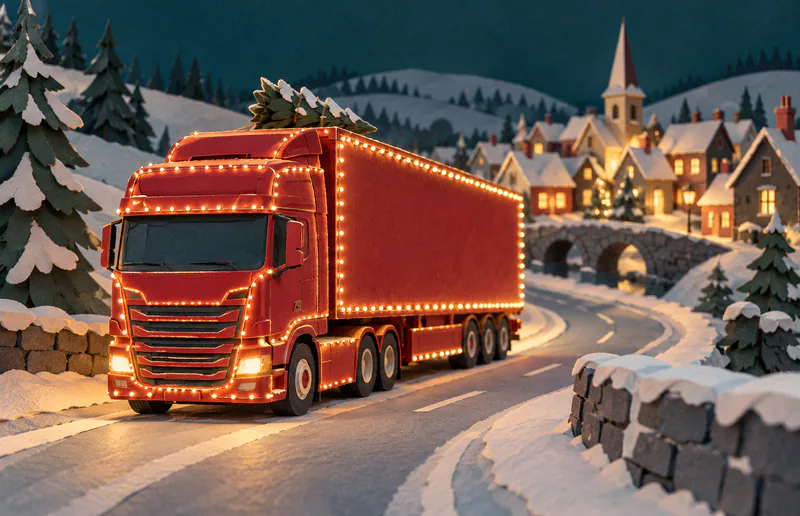
There is an odd little pleasure in recognising a Christmas advert before it has really begun. A red truck, a line of lights, a familiar musical phrase, and you know where you are.
Coca-Cola’s Christmas trucks are unusually good at that. They turn an arrival into the whole event. Nothing needs to go wrong, nobody needs a complicated backstory and the audience does not have to wait for a twist. The convoy comes into view, and anticipation does the work.
For viewers who grew up with the campaign, that recognition can feel like a personal starting bell for Christmas. It is a feeling worth exploring without pretending that everyone shares it, or that the same film has run untouched for three decades.
When did the Coca-Cola Christmas trucks first appear?
The campaign dates to 1995. Coca-Cola’s own historical account, published on its Japanese site, identifies that year as the trucks’ advertising debut. It credits agency W. B. Doner and special effects company Industrial Light & Magic.
The UK’s long association is also visible in a 2015 announcement preserved by Torbay Council. It quotes Coca-Cola Great Britain's marketing director marking twenty years on UK screens, alongside the return of the British truck tour.
Those dates establish the campaign’s history. They do not tell us that every clip labelled “original Coca-Cola Christmas advert” online is the original British broadcast version. A campaign can retain a name and an instantly recognisable image while changing its edit, soundtrack or framing story.
That is particularly easy to forget with an advert whose attraction depends so much on familiarity. We remember the arrival; we may not remember precisely which arrival we saw.
A short timeline of the trucks
| Year | What the evidence records |
|---|---|
| 1995 | The illuminated trucks make their advertising debut. |
| 1998 | Coca-Cola’s history records an international campaign shown in more than 100 countries. |
| 1999 | The “Journey” version uses a boy and his grandfather reading a storybook as its framing story. |
| 2015 | A Coca-Cola Great Britain announcement marks twenty years on UK screens. |
| 2024 | Coca-Cola’s British announcement introduces an AI-generated reinterpretation. |
| 2025 | The global campaign includes two further AI-led versions of the truck film. |
The early milestones come from Coca-Cola’s historical account; the later changes are documented in its 2024 British release and 2025 global announcement.
This is a timeline of selected changes, rather than a year-by-year broadcast log. The 2025 global release also distinguishes versions by territory, including a US-only fantastical film. A global campaign announcement is not proof that every version aired in Britain.
Why the arrival is such a good Christmas story
Our reading of the classic truck idea is that it captures the moment before a celebration. The anticipation is the attraction.
Most Christmas films take us towards something: a journey home, a reunion, a meal, a visitor at the door. The truck campaign reduces that movement to an image. Something bright is coming closer through a wintry landscape. You do not need to know the destination to understand the invitation.
It is an unusually comfortable idea to revisit. A mystery can lose its surprise once you know the solution. An arrival can become more enjoyable because you know what is coming. Think of waiting for the first lights on a familiar street: recognition is part of the pleasure.
There is also a pleasing change of scale. Trucks are ordinary working vehicles. Decorated and moving together, they become a procession. The transformation lets an everyday object occupy the place a sleigh or a magical train might hold in a Christmas story.
None of that makes the advert less commercial. The red vehicles are emphatically branded. The cleverness is that the thing being recognised and the thing announcing the celebration are the same object.
A familiar advert can hold several Christmases at once
Here is the nostalgic possibility: when you see the trucks again, the film may bring an earlier viewing occasion with it.
That might mean a childhood television, a particular living room or the weeks before school broke up. Another viewer may remember the advert from university, or from a first Christmas in a new home. The screen supplies the repeating image; the viewer supplies a changing personal setting.
These are ways the advert can work, rather than claims from a survey about what every British household remembers. Someone who dislikes the campaign, or who never watched it growing up, will bring different associations.
Advertising researcher System1’s 2019 analysis offers a more specific piece of evidence: it describes strong results in its own testing and discusses the value of the campaign’s familiarity. That supports a discussion of tested advertising effectiveness. It should not be inflated into a vote declaring it everyone’s favourite Christmas advert.
The real trucks and the television trucks
A physical truck tour gives the campaign another kind of afterlife. An image that normally passes across a screen becomes something people can stand beside.
The 2015 announcement records the tour alongside the television campaign. Coca-Cola’s 2024 announcement likewise describes both the live tour and the advertising, while identifying that season’s FareShare partnership.
For a fan, those are related experiences, but they are not interchangeable pieces of history. The date a convoy first appeared in an advert does not automatically establish the start of a local tour. Nor does an old tour announcement tell you where a truck will stop this Christmas.
If you are revisiting the campaign for nostalgia, the older announcements are useful records of their own seasons. Treat their locations, promotions and charity arrangements as historical details.
What changes when the familiar picture is remade?
The 2024 and 2025 AI-led films make the distinction between a campaign and a particular film especially clear. Coca-Cola retained the truck idea while changing how new versions were produced.
That raises an interesting question for a Christmas film fan: what exactly do you want to return? Is it the broad image of lights on a red convoy, the music, a specific face, the texture of an older film, or the complete sequence as you remember it?
Different answers can explain different reactions to a remake without requiring anyone to be mistaken about their own nostalgia. Recognising an idea and loving a particular version are separate pleasures.
When choosing a clip to revisit, look for its year and territory as well as its title. And if the picture is not quite the one you remember, that need not mean your memory has failed. You may be looking at another chapter of a campaign that began in 1995 and kept changing around a familiar arrival.
For a different kind of Christmas journey, compare John Lewis's The Journey (2012) and Heathrow's Coming Home for Christmas (2016). The former makes the journey an act of giving; the latter makes arrival a reunion. These are editorial comparisons, not claims of a shared production history.
Explore more returning favourites in the CineClaus Christmas adverts collection.