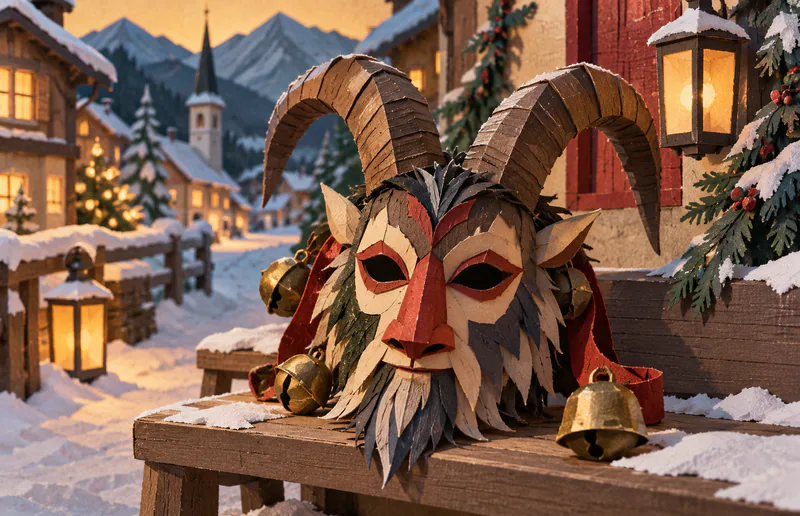
Krampusnacht is the evening of 5 December, the night before St Nicholas's Day, associated with the horned companion who accompanies the saint in Alpine tradition.
St Nicholas brings gifts; Krampus supplies the fright. That pairing is the useful place to start, whether you know the figure from an Austrian parade, Whitby's December celebrations or a Christmas horror film. Local customs vary, and a Krampus run need not happen on the 5th itself.
What happens on the night
In the household tradition, St Nicholas appears as a bishop, with robes and a mitre. Krampus accompanies him to frighten children who have misbehaved. Horns, shaggy fur, bells, chains and a birch switch make him difficult to mistake for the gift-bringer.
Public processions turn that encounter into a much larger spectacle. The masks and costumes are part of the attraction, but so is the sound: bells and drums announce the procession before the figures reach you. It is a costumed performance, even when the name translates as a “run”.
Salzburg's tourist board describes both Krampus and Perchten traditions, and notes that the distinction has become blurred in some modern groups. There is no single costume or programme that represents every town.
Where to see a Krampus run
Salzburg is a useful starting point. Its official listings currently include runs in the Old Town, Linzergasse and the Christmas market on 5 December 2026, with other related events on later dates. Check the individual listing before planning a journey; Krampusnacht is a fixed date, but organisers set their own schedules.
Look for the local term Krampuslauf when searching for an event. A group may be described as a Pass; spellings and plural forms vary in English-language guides. The local tourism or organiser page is more useful than a general list that gives last year's date.
Is Krampus an ancient pagan figure?
The history is more complicated than the familiar story of an ancient god surviving unchanged into Christmas.
Folklorist Ulrike Kammerhofer-Aggermann's account of Krampus and related figures discusses their changing forms and their relationship with St Nicholas customs and religious theatre. That gives us firmer ground than treating every horn or fur costume as proof of an uninterrupted pagan survival.
Alpine masking traditions, church performances and modern clubs have influenced one another. The cautious conclusion is that Krampus has a layered history. A confident claim that he was a particular pre-Christian deity needs evidence of its own; a resemblance between costumes is not enough.
For a visitor, the connection that remains clearest is the one with St Nicholas. Krampus is his frightening companion, rather than simply an evil version of the modern Christmas Eve Santa.
The postcards
Postcards helped carry the figure beyond local celebrations. National Geographic's account of the postcard trade describes its growth after 1890 and the circulation of cards in Austria, Germany and elsewhere before the First World War.
Some are comic, others distinctly threatening. The familiar greeting “Gruß vom Krampus” means “Greetings from Krampus”. A card can make the figure look like a cheerful seasonal mascot; the older images are often much less cuddly.
Krampus in Britain
Whitby has developed its own version of the celebration since 2015, combining the Alpine figure with local folklore and performance.
The organisers list 4–6 December 2026 for Whitby Krampus Run: Zwolf, with the Krampus Ball on Saturday 5 December. Programme details can change, so use that page for current announcements rather than assuming an old route or timetable still applies.
It has not been an uninterrupted series of public parades: the 2020 physical event was cancelled, and the organisers moved the experience online. That is part of the event's history too.
Whitby's streets make an atmospheric setting for masks, bells and winter folklore. You do not have to know every character to enjoy the procession, but it helps to know that the point is a little seasonal unease.
Krampus on screen
Krampus (2015), directed by Michael Dougherty, turns the folklore into a siege story. Adam Scott and Toni Collette lead an extended family whose Christmas quarrels are followed by something much worse arriving with the snow.
Krampus · Film guide →It carries 79/100 Festive Factor for Festive Factor and 20/100 Cosiness Rating for Cosiness. Those measure Christmas content and comfort, not filmmaking quality. This is one for viewers who want the decorations and the danger together. Its UK certificate is 15.
British television followed with Inside No. 9: The Devil of Christmas (2016), a deliberately unsettling take on an old-fashioned television play set in an Austrian chalet. The folklore provides the setting; the episode has its own unpleasant surprises.
Neither is a guide to attending a real event. A household visit or a public procession is a different proposition from a horror film's rules.
Frequently asked questions
When is Krampusnacht? 5 December, the eve of St Nicholas's Day on 6 December. Local visits and public runs may take place on nearby dates.
What does Krampusnacht mean? “Krampus night” in German.
Does Krampus accompany Santa? Traditionally he accompanies St Nicholas. That is related to the wider history of Santa traditions, but it is a different occasion from the familiar Christmas Eve delivery.
What is a Krampuslauf? A Krampus run: a costumed procession. Check the specific event for its format, route and date.
Is Krampusnacht celebrated in the UK? Whitby has an established modern event. Its 2026 weekend is scheduled for 4–6 December.
What is the difference between Krampus and Perchten? Krampus is particularly associated with St Nicholas. Perchten belong to other Alpine winter masking customs. Modern performances sometimes mix the figures, so the distinction is not always visually tidy.
Is the film based on real folklore? Loosely. It borrows the frightening figure and creates its own Christmas-horror story around him.